

Receptionist-Free Office Check-In That Feels Calm
- karl50784
- Jul 23
- 6 min read
A client arrives five minutes early while you are in the middle of a session. They hesitate at the door, unsure whether to knock, wait in the hallway, or announce themselves. You notice the movement, your current client notices you noticing it, and a small interruption changes the tone of the room.
For a small appointment-based practice, receptionist-free office check-in is not just a staffing decision. It is a way to protect the attention you give to the person in front of you while offering the next person a clear, dignified welcome. The best systems make arrival feel simple: clients know what to do, you know they are there, and nobody has to interrupt care to make it happen.
Why arrivals can feel bigger than they look
An arrival is a small moment, but it carries a lot of uncertainty. A new therapy client may already feel vulnerable walking into an unfamiliar office. A patient may not want to say their name or reason for visiting in a shared waiting room. A salon client may wonder whether they have come to the right suite. Even regular clients can feel awkward when there is no one visibly available to greet them.
Without a front desk, many practitioners handle that uncertainty in ways that pull them away from their work. They listen for the door, glance at a hallway camera, ask clients to text when they arrive, or leave sessions briefly to check the lobby. None of these approaches is unreasonable. They simply ask you to divide your attention at the exact moment your client needs it most.
There is a second cost, too. If clients are unsure what to do, they may knock on a treatment-room door, call repeatedly, or wait outside wondering whether they were forgotten. The issue is not that they need a complicated visitor-management process. They need a calm signal that says, “You are in the right place. We know you are here.”
What receptionist-free office check-in should do
A receptionist-free office check-in process works best when it stays focused on presence, not paperwork. Its job is to help an arriving client communicate one thing: I’m here.
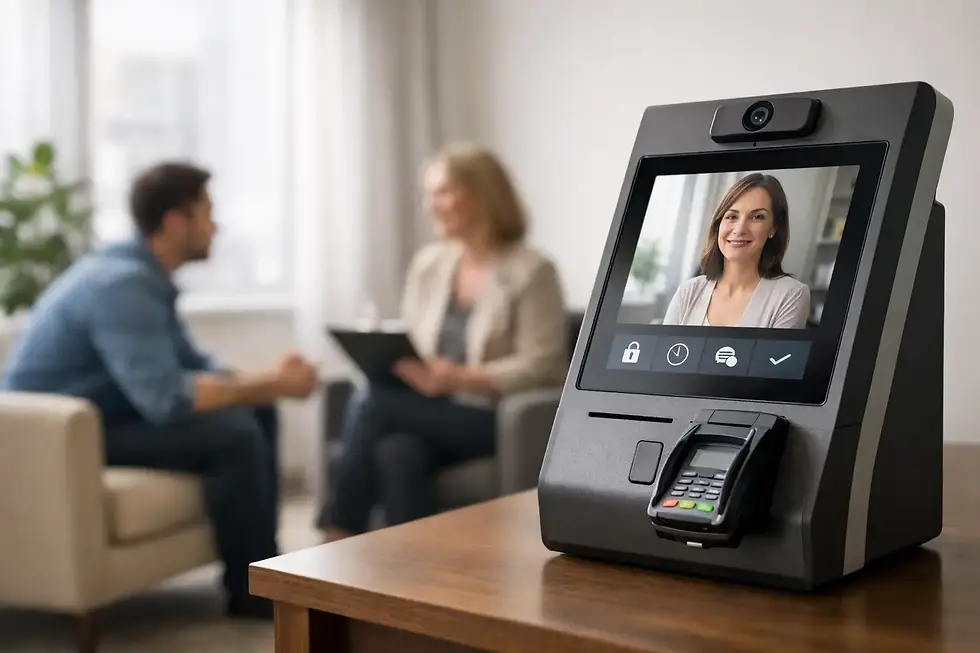
For many solo providers and small teams, that can be as simple as placing an iPad in the lobby or entry area. The client enters their name or selects their appointment, and the practitioner receives a text or email notification. The practitioner can finish the current conversation, treatment, or service without rushing. When the time is right, they can welcome the next client in.
This is a different experience from asking people to download an app, scan a badge, create a profile, or navigate a crowded kiosk. Those tools may make sense in a large corporate building. In a counseling office, acupuncture practice, studio, or small medical suite, they can make a personal space feel strangely transactional.
The right check-in experience is quiet. It gives clients a clear next step without making them feel processed.
A simple arrival flow protects everyone’s attention
The most useful workflow has only three parts: the client checks in on the iPad, you receive a notification, and you continue giving your full attention to the person already with you.
That middle step matters. A notification is less disruptive than a knock on the door, but it still gives you confidence that no one is waiting unnoticed. You do not have to keep one ear tuned to the lobby. You do not have to ask a client to interrupt their own session to answer the door. You have the information you need, without the demand for an immediate response.
For clients, the experience is equally clear. Instead of wondering whether they should speak up, they have a simple action to take. That clarity can ease awkward waiting moments, particularly for people visiting a care setting where privacy and emotional safety matter.
The trade-off: automation should not feel distant
Some practitioners worry that removing a receptionist will make their office feel less welcoming. That concern is valid. A warm greeting has value, especially in spaces built around trust and personal service.
But a front desk is not the only way to communicate care. In a small practice, a thoughtfully placed check-in iPad, a clean waiting area, and a clear message can feel more considerate than an empty desk or a handwritten sign asking clients to knock. The point is not to replace human connection. It is to reserve that connection for the moment you are actually available to offer it.
It also depends on your setting. A busy multi-provider clinic may need a staff member for phones, payments, scheduling changes, and questions throughout the day. A solo therapist who sees one client at a time has different needs. A salon professional working independently may want arrival alerts but still greet every client personally. The best approach fits the rhythm of your practice rather than copying a larger office.
Privacy belongs in the arrival experience
Check-in deserves the same care as the rest of a client journey. That is especially true for therapists, medical providers, and wellness clinicians whose clients may not want to announce themselves in a shared space.
A receptionist-free process can reduce unnecessary conversations in the lobby. Rather than calling out to ask who has arrived or requiring someone to explain why they are there, clients can check in quietly. For practices handling protected health information, the platform itself should also be designed to support HIPAA-compliant communication and appropriate safeguards.
Privacy is not only about compliance language. It is about how a client feels while waiting. A discreet check-in process can help someone feel seen without feeling exposed.
Design the lobby for clarity, not surveillance
A check-in tool works best when clients can understand it immediately. Put the iPad where it is easy to see when someone enters. Keep the screen clean and instructions brief. If your office is inside a larger building, add a simple sign at the suite entrance so clients know they have found the right place.
Think through the practical details before your first appointment. Is the iPad charged and securely placed? Is the screen large enough for clients who may need larger text? Does your office have dependable Wi-Fi, or would cellular connectivity offer more peace of mind? Are notifications reaching the phone or email address you actually monitor during the day?
These details are not glamorous, but they protect the tone of your space. A process that works quietly in the background lets you be more present in the room.
A better alternative to “text me when you arrive”
Many independent practitioners ask clients to text upon arrival. It is familiar, free, and often effective enough. Yet it can blur boundaries and create inconsistency. Clients may text a personal number, send a message too early, forget to text, or expect a quick reply while you are with someone else.
An office check-in system creates a more consistent agreement. Clients use the same simple process each time. You receive the same kind of alert each time. The arrival notification is separate from the back-and-forth communication that may belong in a scheduling system or personal inbox.
It can also make a practice feel more established without making it feel corporate. A client does not need to see a staffed reception desk to feel that their appointment has been anticipated. They need a process that is clear and reliable.
Getting started without adding another project
If a new system requires training manuals, multiple logins, or a long installation process, it can become one more task on an already full list. For small offices, the value comes from a low-friction setup that can be completed in minutes.
Purple Couch App is built around that narrow but meaningful need. It runs on an iPad, lets arriving clients check in, and sends a text or email alert to the practitioner. There is no need to turn your lobby into a reception department. The goal is simply to remove the moment when a client arrives and no one knows what to do.
Before choosing any platform, test it from your client’s perspective. Stand outside your office door. Walk in as though you have never been there. Can you tell where to go? Can you check in without asking a question? Would you feel comfortable doing so while someone else is waiting nearby? If the answer is yes, you have built something useful.
A calm arrival does not need fanfare. It just needs to let clients know they have been expected, while letting you stay fully with the person who is already trusting you with their time.


Comments