

Private Client Arrival Process That Protects Focus
- karl50784
- 3 days ago
- 6 min read
A client opens the door while you are midway through a difficult conversation, a treatment, or a service that deserves your full attention. You may hear the door, wonder who has arrived, and feel pulled toward the hallway even if you stay in the room. A thoughtful private client arrival process removes that split in attention. It lets the arriving person know what to do and lets you remain fully present with the person already in front of you.
For a small practice, arrival is not a minor administrative detail. It sets the emotional tone of the visit. A client who is unsure whether they are in the right place, whether anyone knows they are there, or whether they should interrupt can begin their appointment feeling unsettled. At the same time, asking a practitioner to monitor every arrival can make a calm office feel reactive.
The goal is not to build a corporate front desk. It is to create a quiet, private handoff between the waiting area and the person providing care or service.
What a private client arrival process should do
The best arrival process is simple enough that clients understand it without instruction. It should also respect the reality that many solo practitioners and small teams do not have a receptionist available to greet every person at the door.
A strong process does three things: it confirms that the client has arrived, tells the practitioner discreetly, and gives the client permission to wait comfortably. Nothing more needs to happen in that moment.
That simplicity matters especially in therapy offices, wellness spaces, medical practices, salons, and studios. Clients may be arriving early, feeling nervous, managing pain, carrying personal concerns, or visiting for the first time. They should not have to call out down a hallway, knock on a closed door, or wonder whether they are expected.
Privacy belongs in the process, too. In many settings, it is better not to have clients announce their name aloud or approach a room where another session is in progress. A discreet check-in helps protect confidentiality and reduces the chance of an awkward encounter in a shared space.
The three moments that shape arrival
A private arrival process works best when it is designed around what clients and practitioners actually experience, not around unnecessary office procedures.
1. The client knows exactly what to do
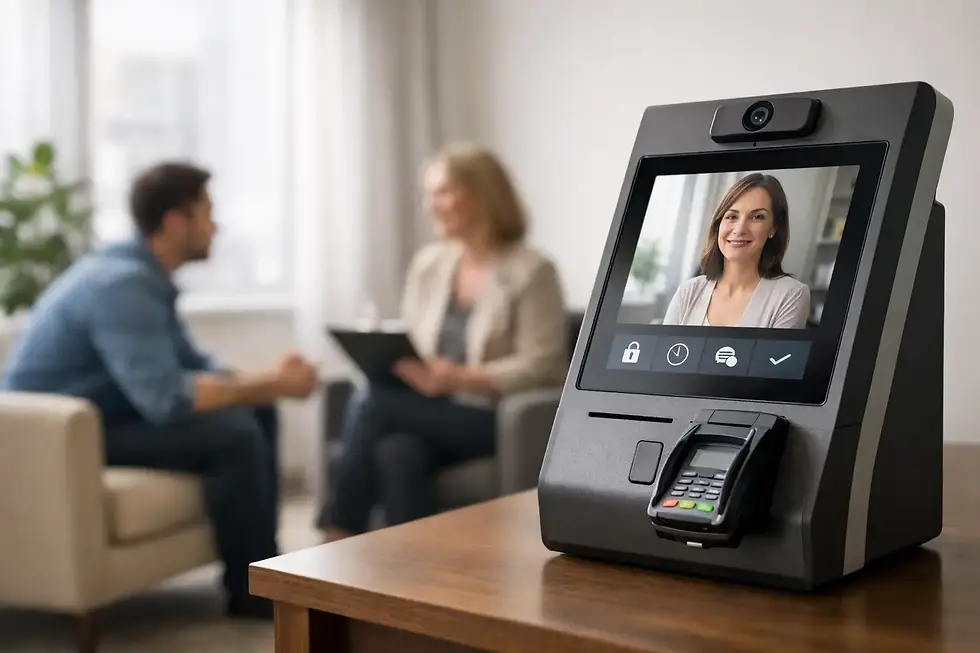
Place a dedicated iPad where it is easy to see as soon as someone enters. The message on screen should be warm and clear: check in when you arrive, then take a seat. Clients should not need an account, a download, or a lesson in how the office operates.
For a first-time visitor, clarity is reassuring. For returning clients, it becomes familiar. They can arrive, check in, and settle without feeling like they need to get someone’s attention.
The physical setting still matters. A visible sign, comfortable seating, appropriate lighting, and a tidy check-in area all reinforce the same message: you are in the right place, and someone knows you are here. Technology cannot replace care in the space, but it can support it.
2. The practitioner receives a quiet notification
Once a client checks in, the practitioner or designated team member needs a reliable signal. A text or email notification is often enough. It provides awareness without forcing anyone to leave a session, stop a consultation, or repeatedly glance toward the door.
This is where the difference between an interruption and a notification becomes meaningful. An interruption asks you to respond immediately. A notification gives you the information while leaving the timing of your response in your hands.
That distinction protects professional boundaries. If you are finishing a session, completing a procedure, or helping another client choose a service, you can wrap up with care. The next client is no longer left wondering whether they have been overlooked, because their check-in has already done its job.
3. The waiting period feels intentional
Most clients do not expect to be greeted the second they enter. They do expect not to feel forgotten. A clear check-in process bridges that gap.
After checking in, clients can wait without guessing whether they should knock or send a message. The practitioner can greet them when ready, rather than being rushed into a transition that shortchanges the current appointment.
This is especially valuable when appointments run a few minutes over. Some work cannot be ended abruptly. A therapist may need to close a conversation thoughtfully. A clinician may need to complete notes or give instructions. A stylist or practitioner may be at a point in the service where stepping away is not practical. The arrival process should make room for that reality without making the waiting client feel ignored.
Why informal workarounds eventually wear people down
Many small offices begin with a workable arrangement: clients knock, send a text, call from the parking lot, or wait until someone notices them. These approaches can function for a while, particularly when schedules are light. But they ask clients and practitioners to carry too much uncertainty.
A knock can be disruptive, even when it is polite. A client text can blend into personal messages or be missed when your phone is silenced during sessions. A waiting client may hesitate to speak up because they do not want to intrude. Meanwhile, you may find yourself listening for the door instead of listening fully to the person you are serving.
There is also a professionalism concern. No one wants clients standing in a hallway wondering whether they should enter, leave, or interrupt. The issue is not that the practice lacks a large reception operation. It is that the arrival experience has not been given a clear, respectful structure.
A dedicated check-in point solves a narrow problem well. It does not need to manage appointments, collect every form, or turn your office into a system of screens and rules. Its job is simply to say, quietly and reliably, “Your client has arrived.”
Design the process around your actual space
There is no single ideal setup for every office. A solo therapist in a shared suite has different needs than a two-room wellness practice or a busy salon studio. The right process depends on the layout, the number of practitioners, building access, and how private the waiting area needs to be.
If your office is inside a larger building, make arrival instructions clear before the appointment. Clients should know which suite to enter and where the check-in iPad is located. In a shared suite, position the iPad so clients can use it without announcing themselves to everyone in the room.
For practices with multiple providers, notifications should go to the right person. This keeps the process personal without requiring a front-desk employee to sort out who is expected. If a team member covers arrivals at certain times, that can be accommodated as well. The process should match the people who are actually present.
Connectivity deserves a practical check. If the office Wi-Fi is unreliable, cellular support can prevent the check-in experience from depending on a weak signal. The point is not to add technical complexity. It is to avoid a small point of friction at the exact moment clients need reassurance.
Purple Couch App is built for this focused role: clients check in on an iPad, the practitioner receives a text or email, and the session already in progress can continue without a verbal interruption. Setup takes minutes, and the intentionally simple workflow supports HIPAA-conscious practices without adding a complicated reception system.
Keep the language warm and low-pressure
The words around check-in influence how clients feel. Avoid instructions that sound demanding or transactional. A simple welcome message is usually enough, along with a gentle note that someone will be with them shortly.
Consider what clients may bring into the room. A counseling client may be anxious before a first session. A patient may be uncomfortable discussing why they are visiting. A salon client may be arriving after a stressful workday. They do not need a complicated process or an explanation of your staffing model. They need to feel expected.
This is also why a private client arrival process should not promise an immediate response if that is not always realistic. “Please check in and have a seat” is more honest than language suggesting someone will appear right away. Clear expectations feel more respectful than rushed apologies later.
A small boundary that improves the whole day
A well-designed arrival process does not eliminate every scheduling delay or unexpected moment. It does create a dependable boundary around them. You know who is waiting. Your clients know they have been acknowledged. No one has to raise their voice, open a closed door, or compete for your attention.
That boundary can change the feel of an entire day. Transitions become calmer. Current clients receive the focus they came for. Arriving clients have a clear next step. And your office continues to feel like a place organized around care, rather than interruption.
The most useful systems are often the ones that make less noise. Give clients a simple way to say, “I’m here,” then let your space answer, “You’re expected.”


Comments