

Receptionist Versus Check-In App: Which Works?
- karl50784
- Aug 5
- 6 min read
A client arrives a few minutes early while you are in the middle of a session. They hesitate in the hallway, knock softly, or take a seat wondering whether you know they are there. You hear the movement and lose a small piece of your attention. This is where the receptionist versus check-in app decision becomes more than an operational question. It shapes the tone of your space.
For many small, appointment-based practices, a full front desk is not realistic or necessary. But the need behind it is real: clients deserve a clear, welcoming arrival, and practitioners need to stay present with the person in front of them. The right answer depends on the kind of support your practice needs at the moment a client walks through the door.
What a receptionist makes possible
A great receptionist offers something technology cannot fully replace: human judgment. They can greet a nervous new client, answer a complicated scheduling question, help someone who arrived at the wrong time, accept a payment, or notice when a person needs extra care. In a busy multi-provider office, they can also manage competing needs in real time.
That personal welcome matters most when arrivals are unpredictable or the front desk handles a broad range of tasks throughout the day. Medical offices with frequent walk-ins, practices with high call volume, or businesses that process payments and paperwork at arrival may benefit from having a dedicated person there.
A receptionist can also create continuity. Regular clients may appreciate being known by name. For certain offices, especially those with a larger team and a steady flow of people, a warm front-desk presence is part of the service itself.
Still, a receptionist is not simply a greeting. It is a staffing role with a salary or hourly wage, hiring time, coverage needs, training, payroll, and the challenge of filling gaps when someone is sick or on vacation. For a solo therapist, acupuncturist, stylist, or studio owner, that can be far more support than the daily arrival problem requires.
Where the front desk model can feel out of proportion
Many practitioners do not need someone to manage a lobby all day. They need one small moment handled well: a client arrives, confirms they are there, and the practitioner is quietly notified.
Hiring for that narrow need can create a mismatch. A receptionist may spend long stretches waiting for the next arrival, while the business owner takes on the cost and responsibility of another employee. Some small offices try to solve this by having a practitioner, assistant, or shared building staff cover the desk. That often works until it does not.
The interruption usually lands in the same place: on the person who is actively serving a client. A therapist has to decide whether to pause a difficult conversation. A salon professional may stop mid-service to see who has entered. A wellness provider may feel pulled between honoring privacy in the room and making sure a waiting client does not feel forgotten.
Even a polite knock can shift attention. The issue is not that clients are doing anything wrong. They are trying to let you know they have arrived. The problem is that the arrival process asks them to interrupt someone else in order to be seen.
Receptionist versus check-in app: the practical difference
A check-in app is not a receptionist in digital form. It is a focused alternative for offices that do not need full-time front-desk coverage.
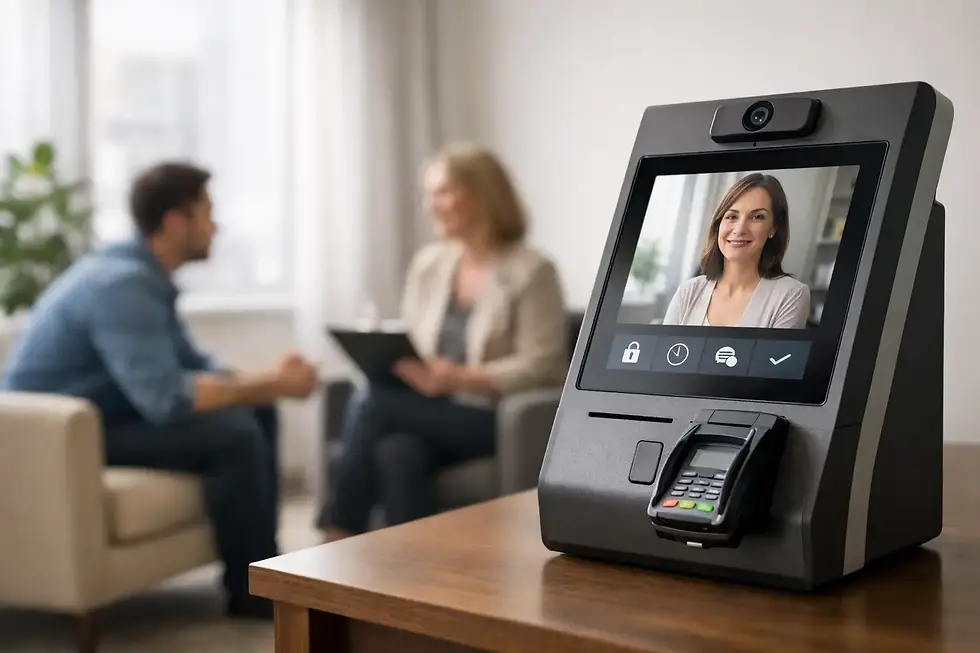
Instead of waiting uncertainly or knocking, a client checks in on an iPad in the lobby. The practitioner receives a text or email notification and can continue the current appointment without breaking the flow. The arriving client gets confirmation that they have been noticed, while the client already in the room keeps your full attention.
That is a small exchange, but it changes the atmosphere. There is less hallway hovering, less guessing, and fewer awkward waiting moments. The space feels organized without feeling overly managed.
For a solo or small practice, this approach is often more proportionate to the problem. You are not trying to recreate a corporate reception desk. You are creating a clear, respectful arrival ritual that protects presence.
A simple iPad check-in system can be especially useful when your day is structured around back-to-back appointments. If clients tend to arrive within a predictable window and most questions are handled before the visit, a notification may be all you need to keep things flowing.
Cost is only one part of the comparison
The financial difference is straightforward. A receptionist is an ongoing staffing investment, along with the costs of management, coverage, and turnover. A check-in app is typically a modest monthly subscription and an iPad already in the office or purchased for that purpose.
But the less obvious cost is interruption. When a practitioner leaves the room, turns toward the door, or watches the clock for an arrival, they are spending attention that belongs to the current client. In care-centered work, that cost can be felt even when it only lasts a few seconds.
A check-in app does not eliminate every task associated with a front desk. It will not resolve an insurance question, calm an upset visitor, or answer phones during a busy day. It is best viewed as a simple arrival tool, not an all-purpose office management system.
That limitation is a strength for practices that want less complexity. There is no need to build a large administrative workflow around a problem that has a clean, contained solution.
Privacy changes the equation
For therapists, counselors, medical providers, and other confidential services, the arrival experience carries privacy concerns. Clients may not want to announce themselves aloud in a shared hallway. They may feel exposed if they have to knock on a treatment room door or explain why they are there to another person.
A quiet check-in gives clients a more discreet way to arrive. They can confirm their presence without sharing details with others nearby. The practitioner receives the notification privately and responds when the current session has reached a natural stopping point.
Of course, privacy depends on implementation. The iPad should be positioned so the screen is not easily viewed by people passing by, and the check-in experience should ask only for what is necessary. For practices subject to HIPAA requirements, choose a platform designed with those responsibilities in mind.
Purple Couch App was built around this exact moment: a simple iPad check-in, a private text or email notification, and no need to interrupt the session already underway. The point is not to add another complicated system. It is to make arrival feel handled.
When a receptionist is still the better choice
There are clear situations where a person at the front desk remains the better fit. If your office manages frequent walk-ins, fields constant phone calls, handles payment questions at arrival, coordinates multiple providers, or serves clients who may need hands-on assistance, human coverage can be essential.
The same is true when the front desk is a meaningful part of your brand experience. A high-touch salon, a large specialty clinic, or a practice with a bustling shared waiting room may need someone who can read the room and respond with care.
The choice does not have to be permanent, either. A growing practice may begin with a check-in app, then add reception support as appointment volume and administrative needs increase. Another office may use a receptionist on selected high-volume days and an iPad check-in on quieter days. The best setup matches your actual workflow, not an idea of what a professional office is supposed to look like.
How to choose for your practice
Start with the arrival moments that feel hardest right now. Are clients interrupting sessions because they do not know how else to announce themselves? Do they wait anxiously because you cannot see the lobby? Or are you already managing a full range of front-desk needs that require a person on site?
A receptionist is likely the right investment when you need active, ongoing human coordination. A check-in app is likely the right fit when the primary goal is simple: let clients arrive confidently and let practitioners know, without pulling attention away from the room.
Also consider the emotional tone you want to protect. In a therapy office, the quiet after a client shares something difficult should not be broken by a knock. In a treatment room, the person on the table should not feel that the next appointment is competing for your attention. In a studio or salon, clients should not have to wonder whether anyone knows they are waiting.
The most effective arrival process is often the least dramatic one. A client walks in, checks in, and settles comfortably. You receive a quiet notification. The session in front of you continues with care. Everything simply has room to flow.


Comments