

Private Practice Check-In That Protects Your Focus
- karl50784
- Aug 1
- 6 min read
A client arrives early, opens the door quietly, and is not sure what to do next. Meanwhile, you are in the middle of a session that deserves your full attention. That small moment is where a thoughtful private practice check-in makes a real difference. It gives the arriving client a clear next step without asking you to leave the person already in front of you.
For small practices, the challenge is rarely a complicated scheduling problem. It is the interruption at the door: the knock, the hallway question, the need to glance at a phone, or the uneasy feeling that someone may be waiting without knowing they have been noticed. A calm arrival process protects more than your calendar. It protects the tone of your space.
Why arrivals can feel bigger than they look
In a large office, a front desk absorbs the small moments around an appointment. In a solo therapy practice, wellness office, studio, or salon, those moments often land directly on the practitioner. You may hear the door open during a vulnerable conversation. You may need to step out briefly to greet a client, then return and try to restore the focus of the room.
Even when the interruption lasts less than a minute, it can change the experience for everyone involved. The current client may feel their time has been divided. The arriving client may wonder whether they are in the right place, whether they should knock, or whether they have been forgotten. You are left managing both concerns at once.
Some practices solve this with signs, a doorbell, or instructions to text upon arrival. Each can work in the right setting, but each asks the client to make a judgment call. Should they knock? Is it okay to text? Did the message go through? A check-in process removes that uncertainty with one clear, welcoming action.
What a private practice check-in should do
The best check-in system for a small, appointment-based office is not trying to become a full front desk. It does one job well: it lets a client say, clearly and privately, I am here.
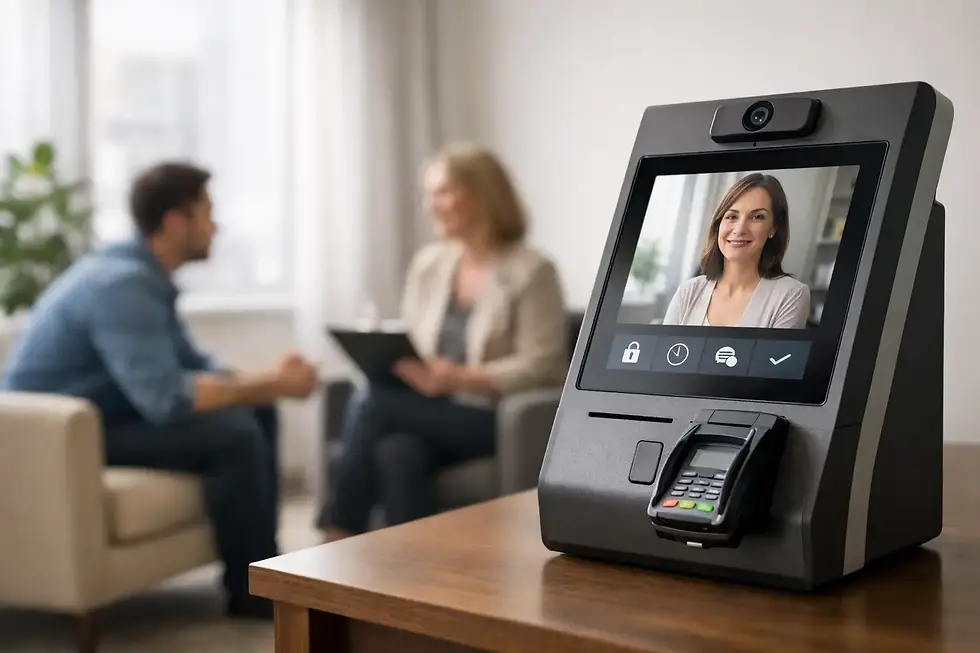
For many practices, that means placing an iPad where clients can see it when they arrive. They enter their name or make a simple selection, and the practitioner receives a text or email notification. The client can take a seat knowing their arrival has been acknowledged. The practitioner can finish the current session without breaking the moment.
That simple exchange creates a better boundary. You do not need to monitor the door or repeatedly check a waiting area. Your client does not need to interrupt someone else’s appointment to get your attention. Everyone knows what happens next.
A good private practice check-in also respects the nature of the work. In therapy and healthcare settings, privacy matters from the first interaction. In a salon or studio, the arrival should still feel polished and personal rather than transactional. The system should be easy enough for first-time clients to use without explanation and quiet enough that it does not add another distraction to the room.
The three moments that change the arrival experience
A calm check-in is often built around three simple moments.
1. The client sees a clear place to check in
Clients should not have to search for instructions taped to a door or wonder whether they are expected to announce themselves. An iPad placed at the entrance or in the waiting area gives them an immediate answer.
Keep the language warm and direct. A simple greeting and a clear check-in prompt are usually enough. This is not the place for a long intake form, account creation, or a list of policies. Arrival is already a transition. Make it easy.
2. You receive a quiet notification
Once the client checks in, you receive a text or email. You know they are there, but you do not have to act on that information immediately. If you are wrapping up a session, you can finish naturally. If you are available, you can greet them when the moment is right.
That distinction matters. The notification is not a demand for your attention. It is reassurance that you no longer need to wonder who is waiting or whether someone slipped in unnoticed.
3. The current session stays intact
The real value is what does not happen. No knock at the door. No rushed apology. No client pausing mid-thought while you step into the hallway. No awkward waiting moment for the person who just arrived.
Your focus never has to break just because the next appointment is on time.
When a check-in app makes sense
A dedicated check-in tool is especially helpful when you work alone, share office space, or have only occasional administrative support. It can also be useful for small teams whose schedules overlap but who do not want a staff member assigned to watch the entrance all day.
For a therapist, the priority may be holding a confidential, uninterrupted session. For an acupuncturist or physician, it may be knowing a patient has arrived without leaving a treatment room. For a salon professional or studio owner, it may be creating a more polished welcome without adding payroll or a formal reception desk.
It depends on your space and the expectations you have already set with clients. If every appointment is held virtually, a lobby check-in is not relevant. If you have a staffed reception desk throughout the day, the need may be smaller. But for the many offices in between, a simple check-in process can take away a recurring source of friction.
What to look for before you choose one
The goal is less technology, not more. Before adding any system, consider whether it fits naturally into your routine.
First, look for a setup that takes minutes rather than an afternoon. You should be able to put the app on an iPad, choose how you want to be notified, and place the device in your waiting area. If the setup requires extensive training, hardware, or a complicated client database, it may be solving problems your practice does not have.
Second, consider connectivity. Reliable Wi-Fi is common, but some offices have inconsistent service or waiting areas that sit outside the strongest signal. A solution that can work with cellular-capable iPads gives you more flexibility.
Third, consider privacy and the information clients see. For healthcare and therapy practices, HIPAA compliance is a necessary baseline. More broadly, the check-in screen should avoid putting unnecessary client details on display. A calm, private experience begins before you open the door.
Finally, think about the notification itself. Text and email options give you room to choose what works while you are seeing clients. Some practitioners prefer a text for speed. Others prefer email so arrival notices stay separate from personal messages. The right choice is the one you will notice without letting it pull you out of the session.
A simple approach for small offices
Purple Couch App was designed around this exact moment: a client checks in on an iPad, you receive a notification, and you continue giving your full attention to the person you are with. There is no need to build a front-desk operation around it. The workflow is intentionally small because the relief it provides is immediate.
That simplicity also makes it easier to introduce. You can tell clients, in person or in an appointment reminder, that they should check in on the iPad when they arrive. Most people understand the process right away. For clients who need assistance or have accessibility concerns, you can still offer a personal alternative. A check-in tool should support your hospitality, never replace it.
Questions small practices often ask
Will clients know how to use it?
Usually, yes. A visible iPad with a short prompt is familiar to most people. Clear placement and a brief welcome message do more than extra instructions ever could.
Do I need a receptionist to make this work?
No. The point is to give clients a way to announce their arrival without requiring someone to sit at a desk. You remain in control of when you respond.
Is this only for medical or therapy offices?
No. Any appointment-based space where one person needs to stay focused on another can benefit. The details of the welcome may differ, but the need for a clear, respectful arrival is shared.
A private practice is often built on the quality of attention you give people. Protecting that attention does not require a bigger office, another staff member, or a more complicated system. Sometimes it starts with giving the next person who walks through the door a quiet, confident way to say they are here.


Comments