

Visitor Management Software for Calm Offices
- karl50784
- Aug 17
- 6 min read
A client opens the door halfway through a session. You hear them arrive, wonder whether they know where to sit, and feel the pull to step out and acknowledge them. Even when the interruption lasts only a few seconds, your attention has shifted away from the person in front of you.
Visitor management software can solve this small but meaningful problem. For appointment-based offices without a full-time receptionist, it creates a clear, private way for clients to announce their arrival without knocking, waiting awkwardly in a hallway, or asking someone else to interrupt your work.
The best solution is not necessarily the one with the longest feature list. It is the one that helps clients feel expected while allowing you to stay fully present.
What visitor management software should do in a small office
Visitor management software is often associated with large offices, corporate lobbies, badge printers, security desks, and complicated approval workflows. Those systems have a purpose. A building with hundreds of daily visitors may need visitor records, photo IDs, access permissions, and detailed reporting.
But a therapy office, salon suite, wellness practice, or small medical office has a different kind of arrival problem. The concern is usually not controlling access to a building. It is making sure a client can arrive with confidence while the practitioner remains focused on the appointment already in progress.
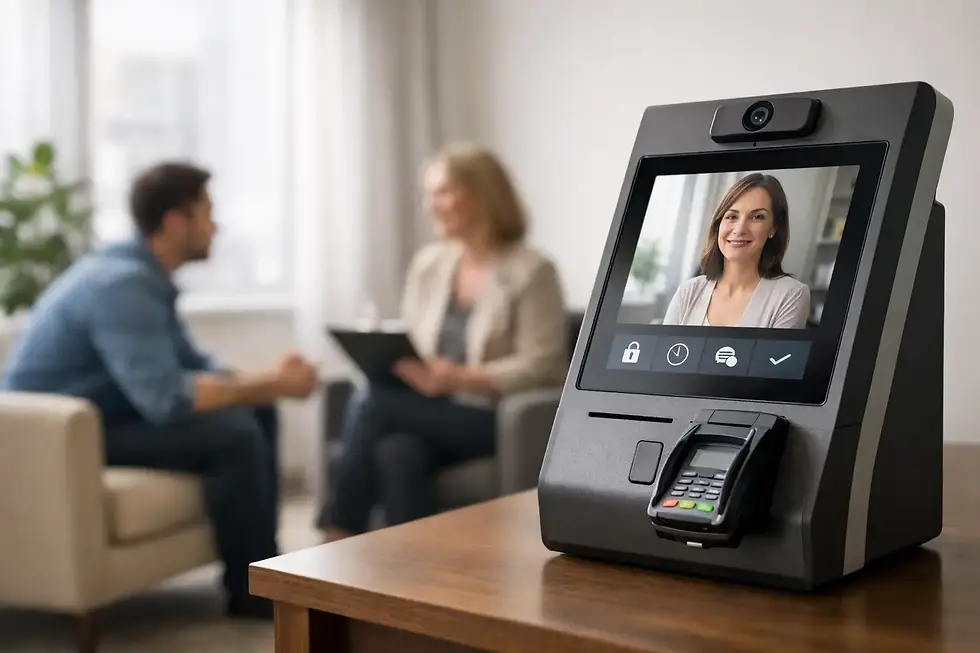
For a small appointment-driven space, visitor management software should make one moment easier: arrival. A client checks in on an iPad, you receive a discreet text or email, and you continue your session until it is time to greet them. There is no need to monitor the door, keep a clipboard at the front desk, or rely on clients to decide whether they should knock.
That simplicity matters. A system can be technically impressive and still feel wrong for a quiet, personal practice if it asks clients to complete too many steps or makes the lobby feel like a corporate reception area.
The arrival interruption has a human cost
Most practitioners do not want a client to feel ignored. That is why arrivals can be distracting in the first place. When someone enters and there is no one at the front desk, they may look uncertain. They may stand outside a closed door, send a message, or knock even when they suspect you are with another client.
Meanwhile, you are placed in an uncomfortable position. You want to be welcoming to the next person, but you also want to honor the time and privacy of the person sitting with you. Repeated interruptions can make sessions feel rushed, particularly in work that depends on trust, confidentiality, concentration, or emotional safety.
A clear check-in process removes the guesswork for everyone. Clients know what to do when they arrive. You know they are there without having to leave the room. The waiting period becomes a normal part of the visit rather than an awkward waiting moment.
This is especially useful when appointments run close together. A client who arrives early can check in and settle quietly. A practitioner finishing a meaningful conversation does not have to cut it short simply because they heard the door open.
The essentials are simpler than they sound
For many small offices, a good system begins with a dedicated iPad in the lobby or waiting area. The screen should be easy to understand at a glance, even for a first-time client. They should not need to download an app, create an account, or hand over more personal information than the check-in requires.
The notification should be immediate and discreet. A text or email lets you know the client has arrived without requiring a loud alert, an intercom, or someone calling into your treatment room. You can see the notification when it is appropriate to do so and greet the client when you are ready.
Privacy also deserves careful thought. In a counseling practice, medical office, or other sensitive setting, the waiting area should not invite clients to announce private details aloud. A simple self-check-in experience supports a more respectful boundary. If your work involves protected health information, look for a provider designed to support HIPAA compliance and the privacy expectations of your practice.
Finally, consider the reality of your space. Some offices have inconsistent Wi-Fi, shared buildings, or a lobby that is not close to the treatment room. An iPad setup with dependable connectivity options is more useful than a complicated desktop system that assumes someone is always at a reception desk.
How a quiet check-in workflow works
The most effective workflow is almost invisible. A client arrives and checks in on the iPad. You receive a text or email notification. You finish giving your current client the attention they deserve, then welcome the next person when the appointment can begin.
There is no handoff to manage and no receptionist schedule to coordinate. The system does not replace a warm greeting. It protects the conditions that make that greeting feel genuine.
Purple Couch App is built around this kind of arrival experience for small, client-centered offices. Its iPad-only approach keeps setup focused: place the device where clients can find it, choose how you want to be notified, and establish a consistent check-in routine. For many practitioners, that can be done in minutes rather than becoming another office project.
A calm workflow also benefits your team, if you have one. In a shared practice, each practitioner can receive the right notification without asking a colleague to watch the lobby. In a salon or studio, a service provider can avoid stepping away while they are mid-appointment. The principle stays the same: the person already being served should not lose your attention because someone else has just arrived.
Choosing visitor management software without overbuying
When comparing visitor management software, start with the experience you want clients to have rather than a long checklist of features. Ask whether the software solves a real problem in your office or adds another process for you and your clients to learn.
A larger facility may truly need visitor badges, ID scanning, legal agreements, access control, and detailed audit records. If you manage a multi-tenant building, host frequent vendors, or operate in a high-security environment, those capabilities may be worth the added complexity.
For a solo or small appointment-based practice, though, extra administration can become a burden. If the system requires visitors to use a kiosk with multiple screens, print a badge, or select from a directory, it may create more friction than reassurance. You are not trying to run a lobby like a headquarters. You are trying to make arrival feel clear and considerate.
Pricing should be equally straightforward. Before choosing a platform, check whether core features are included, whether there is a long contract, and what happens if your practice changes locations or staffing. A flexible monthly subscription can make more sense for an independent practitioner than an enterprise plan built for a very different kind of office.
Practical questions before you set up
Will clients know what to do?
They should. Put the iPad in a visible, welcoming place and use a brief sign if your lobby layout makes the check-in point easy to miss. The instructions should be simple enough that you do not need to explain them repeatedly. A first-time client should be able to arrive, check in, and sit down without wondering whether they have done it correctly.
What happens if I am in a session?
That is the point of the system. The notification confirms that the client is there, but it does not require an immediate response. You can maintain your professional boundary, complete the current conversation or service, and transition at the appropriate time.
Does this replace a receptionist?
For routine appointment arrivals, it can remove the need for someone to monitor the lobby full time. It does not replace the judgment, hospitality, or coordination a receptionist may provide in a larger office. It simply handles one recurring task well: letting you know that someone has arrived.
What if my connectivity is unreliable?
Check the options before you commit. Some iPad-based setups can work with cellular service, which may be helpful in offices where Wi-Fi is inconsistent or unavailable in the waiting area. The right choice depends on your location and how much you rely on notifications arriving immediately.
Let your entryway support your work
The tone of your space begins before the appointment starts. When clients know how to check in, they are less likely to feel uncertain at the door. When you know they have arrived, you are less likely to split your attention between the waiting area and the person who is already with you.
A thoughtful check-in process is a small operational decision with a personal effect. It gives clients a calmer welcome, gives practitioners room to stay present, and helps the whole day flow with a little more care.


Comments