

The Receptionist and the Tone of Your Office
- karl50784
- Aug 13
- 6 min read
A client arrives a few minutes early, opens the door quietly, and realizes no one is at the desk. Meanwhile, you are in the middle of a session, treatment, consultation, or appointment that deserves your full attention. This is the moment the receptionist has traditionally managed - but for many small practices, it is also the moment that creates the most awkward waiting moments.
The challenge is not simply whether someone answers the door. It is what the arrival experience communicates. A client who is unsure where to sit, whether they have been noticed, or whether they should interrupt may feel unsettled before their appointment even begins. A practitioner who hears the door, pauses a meaningful conversation, and rushes into the hall may lose the focus they worked hard to create.
For appointment-driven offices without a full-time front desk, the real question is not, "Do we need a receptionist?" It is, "How do we make every arrival feel acknowledged while protecting the person already in our care?"
What the Receptionist Has Always Protected
A receptionist does more than schedule appointments or answer phones. At their best, they help hold the emotional tone of a space. They offer a clear welcome, reduce uncertainty, and create a transition between the outside world and the appointment ahead.
That role is especially meaningful in settings where people arrive carrying nerves, discomfort, vulnerability, or simply a full day. A therapy client may be preparing to discuss something personal. A patient may be worried about a procedure. A salon guest may have set aside limited time to feel cared for. Even in a studio or wellness practice, a warm and organized arrival sets an expectation: you are in the right place, and your time matters here.
A staffed reception desk can provide that reassurance. It can also be more than a small business needs. Hiring a full-time receptionist comes with payroll, scheduling coverage, training, turnover, and the difficult reality that many solo practices do not have enough constant front-desk activity to justify the expense. Some offices need help with calls and billing. Others mainly need a graceful way to handle arrivals.
Those are different needs, and they should not require the same solution.
When a Front Desk Is Not the Right Fit
There is nothing unprofessional about operating without a receptionist. For many practitioners, it is a thoughtful choice. A smaller office can feel personal and calm. It can allow the practitioner to stay close to the work rather than adding layers of administration that do not serve clients.
The trade-off is that someone still has to receive each arrival. If that responsibility falls to the practitioner, interruptions become part of the day. A knock at the door can pull attention away from a client who is sharing something difficult. A glance into the hallway can disrupt a treatment. Leaving the room to greet the next appointment can make the current client feel rushed, even when that was never the intention.
Clients notice interruptions too. They may not complain, but they feel the shift. The practitioner is no longer fully present. The room changes from a protected place into a place where the next appointment is already pressing in.
A phone call is not always better. Calling or texting a practitioner directly can put the arriving client in the uncomfortable position of deciding whether their presence is urgent enough to interrupt. Asking clients to wait silently can create the opposite problem: they wonder whether anyone knows they are there.
The best approach depends on the practice. A busy medical office with several providers may benefit from a staffed front desk. A salon with walk-in traffic may need a person who can answer questions and guide guests. But a solo therapist, acupuncturist, or independent clinician often needs something simpler: a clear, private signal that a client has arrived.
A Better Arrival Does Not Need a Bigger System
For a small office, check-in should be easy enough that it fades into the background. The client arrives, checks in, and knows they have been seen. The practitioner receives a discreet notification and continues the current appointment without breaking the moment.
That small shift changes the experience for everyone.
The arriving client does not need to knock, call out, or wonder what to do. The client already in the room does not have to watch their provider split attention. And the practitioner does not have to choose between being welcoming and being present.
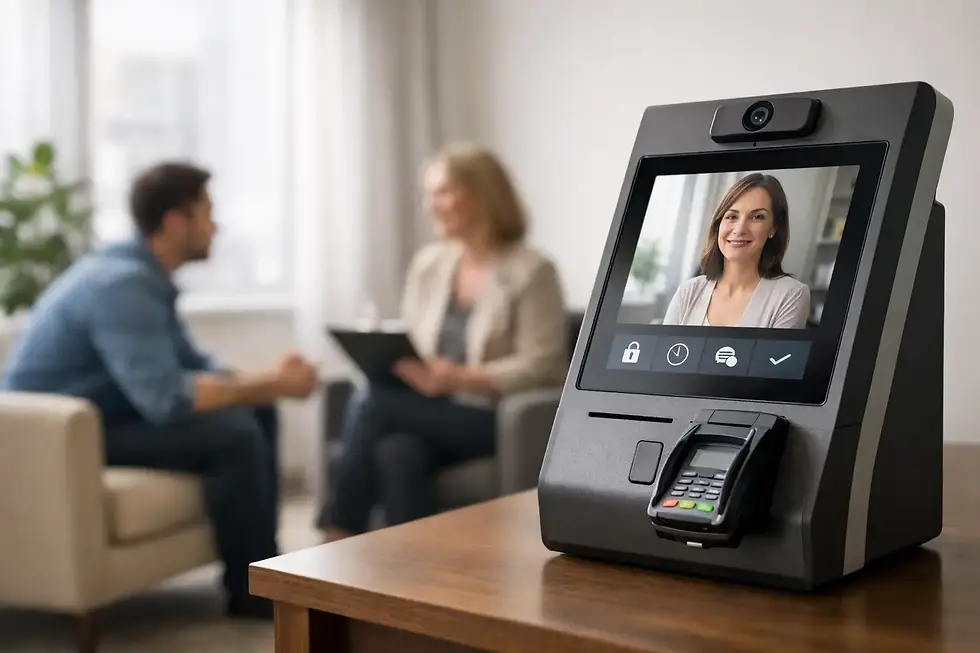
This is where a simple iPad check-in can serve the most valuable part of the receptionist's role without recreating an entire front-office operation. Purple Couch App, for example, is designed for this exact moment. A client checks in on an iPad in the lobby, and the practitioner receives a text or email notification. There is no complicated visitor-management process, no need to track arrivals manually, and no expectation that clients learn a new system.
The goal is not to make your office feel automated. It is to remove the friction that makes people feel overlooked.
The Small Details Clients Remember
People rarely remember the mechanics of checking in when it works well. They remember whether the space felt considered.
A clear sign near the entry can make a first-time client feel more comfortable. A visible iPad at a tidy check-in area gives them an immediate next step. A short message such as "Please check in when you arrive" is often enough. The point is not to overexplain. It is to replace uncertainty with a simple invitation.
Privacy matters here as well. In therapy, healthcare, and wellness settings, clients may not want to announce their name in a shared hallway or wait until someone is available to acknowledge them. A private check-in process helps preserve discretion from the first minute they enter.
Timing also matters. When a practitioner knows a client has arrived, they can finish the current appointment with care rather than being caught off guard by a knock. If they are running a few minutes behind, they can make a deliberate choice about how to respond. That is different from reacting to an interruption in the middle of a conversation.
A calm arrival process supports better boundaries, too. It gives each appointment a beginning and an end. The next client is welcomed without being pulled into the previous client's time, and the current client is not made to feel as though their session has already ended before it actually has.
Designing a Check-In Experience That Feels Human
Technology can either add distance or reduce it. The difference comes down to whether it asks people to do too much.
For a small practice, a check-in experience should ask for very little. The screen should be easy to understand. The device should stay in one familiar place. Notifications should go to the person who needs to know, without making the client repeat information or navigate multiple steps.
Before relying on any check-in tool, consider the practical realities of your office. Will the iPad remain charged and visible? Does the space have reliable Wi-Fi, or would cellular connectivity be useful? Can clients of different ages and comfort levels use it without assistance? Does the system respect the privacy expectations of your profession?
These questions are not about adding complexity. They are about choosing a process you will actually trust on a busy day. A tool that requires constant troubleshooting or lengthy training can become one more thing competing for your attention.
The right setup should feel like part of the room. It should support the tone you have already worked to create: quiet, welcoming, organized, and attentive.
Presence Is the Real Service
A receptionist may be the right choice for some offices, particularly when calls, walk-ins, payments, and multiple providers demand ongoing support. But for many independent professionals, the most essential service of a front desk is much smaller and more personal: letting people know they have arrived and making sure the practitioner knows it too.
When that exchange happens quietly, your focus never has to break. Your clients are not left guessing. The person in front of you receives your full attention until their time is complete.
That is not a lesser version of hospitality. It is hospitality designed around presence - and in a client-centered practice, presence is often the thing people feel most.


Comments