

Small Office Check-In Guide for Calm Arrivals
- karl50784
- 7 days ago
- 6 min read
A client arrives early, opens the door quietly, and looks around for direction. You are halfway through a session. Do you pause to greet them, trust that they will wait comfortably, or hope they know what to do? A thoughtful small office check-in guide starts with this ordinary moment, because it can shape the experience of both the arriving client and the person already in your care.
For a solo therapist, a wellness clinician, a salon professional, or a small studio owner, arrivals are not just an administrative detail. They can create awkward waiting moments, pull your attention away from a meaningful conversation, and make a private space feel unexpectedly exposed. The right process does not need to feel corporate. It simply gives people a clear, respectful way to say, “I’m here.”
Begin with the tone you want clients to feel
Before choosing a check-in method, consider what a client sees and feels in the first 30 seconds. Are they entering directly into a quiet hallway? Do they need to wait near a treatment room? Is there a shared lobby where they may not know who to approach? These details determine whether a simple sign is enough or whether a more intentional process will make a real difference.
The goal is not to add another layer to your day. It is to remove uncertainty. Clients should know where to go, what to do, and that you know they have arrived. Meanwhile, you should be able to stay present with the appointment in front of you.
A calm arrival process usually has three qualities: it is obvious, private, and low effort. Obvious means no one has to guess whether they should knock. Private means clients do not need to announce their name across a waiting area. Low effort means it works even when you are running a few minutes behind or moving between rooms.
Map the arrival experience before adding technology
Walk into your office as though you are a first-time client. Stand at the entrance. Notice whether the path to the waiting area is clear, whether the door needs instructions, and whether there is an intuitive place to check in. This small exercise often reveals friction that you have stopped noticing.
A door sign can be useful when the office layout is simple and you can reliably see or hear arrivals. It may say that clients are welcome to take a seat and that you will be with them shortly. But signs have limits. They do not tell you who has arrived, and they may leave a client wondering whether they have been noticed.
Texting can work for some businesses, particularly when clients are used to communicating with you directly. The trade-off is that it puts the burden on the client to find the right number, compose a message, and assume you are able to read it. It can also blur a boundary you may prefer to keep clear, especially if your personal phone number is involved.
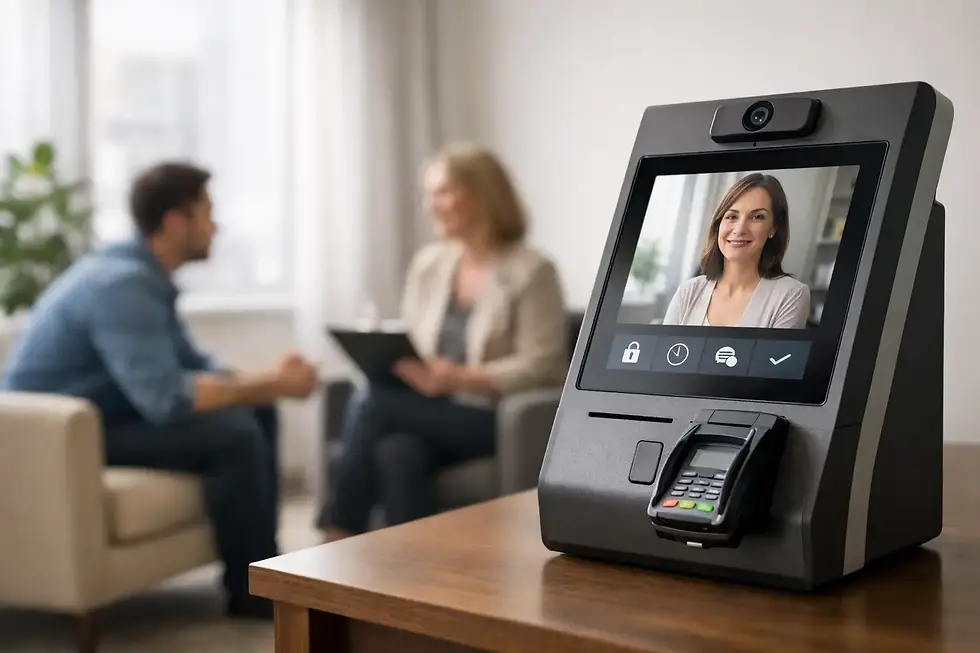
For many appointment-based offices, a dedicated check-in point is the most comfortable middle ground. A tablet in the lobby gives each arriving person a clear next step without requiring a receptionist or an interruption at your door.
Create a small office check-in flow that stays out of the way
The best check-in process is short enough that clients do not need instructions beyond a friendly prompt. In practice, that means placing an iPad where it is easy to see, displaying a simple welcome message, and asking for only the information needed to identify the arriving person.
From there, the workflow should be equally simple: the client checks in, you receive a discreet text or email notification, and you continue your current session until it is time to greet them. There is no need for a client to knock, call out, or wonder whether they are waiting in the right place.
Keep the language on the screen warm and direct. “Welcome. Please check in and have a seat” feels more inviting than “Enter visitor information.” The difference may seem small, but it protects the tone of your space. Your office is not a lobby for a large institution. It is a place where people may arrive carrying nerves, discomfort, anticipation, or something personal they are not ready to explain.
Put privacy ahead of convenience
In therapy, healthcare, and many wellness settings, an arrival can reveal more than a schedule. A client may not want to say their full name aloud or discuss why they are there in front of another person. Even in salons and studios, discretion signals respect.
Set up your check-in process so clients can identify themselves privately on the device. Avoid screens that display a visible queue of names or appointment details. Keep notifications discreet as well. A simple arrival alert is generally more appropriate than a message containing sensitive context.
If your practice handles protected health information, choose tools and procedures that support HIPAA-compliant workflows. Privacy also extends beyond compliance. It is the feeling clients get when they realize your systems were designed with their dignity in mind.
Make the waiting area answer unspoken questions
A check-in tool cannot compensate for a confusing space. Pair it with a few considerate details: clear seating, a visible restroom direction if relevant, and a brief note about what happens next. If clients regularly arrive early, let them know whether they are welcome to wait inside or should arrive closer to their appointment time.
You do not need a decorative reception desk or a long list of instructions. In fact, too much signage can make a small space feel tense. One clear message, one obvious check-in point, and a comfortable place to sit are often enough.
Decide how you want to receive arrival notifications
A notification should help you stay aware without demanding an immediate response. Text messages are useful when you move around the office, step outside between appointments, or do not spend the day at a computer. Email may suit practitioners who keep a desktop or laptop open for scheduling and notes.
It depends on how you work. If a text alert is likely to disrupt your focus while you are with a client, silence the notification sound and glance at it during a natural transition. If you are often in a treatment room where your phone is not nearby, an email on a connected device may be more practical.
The point is not to react instantly to every arrival. It is to remove the uncertainty. You know the client is there, and the client knows they have checked in. That shared clarity makes a short wait feel far more intentional.
Keep setup simple enough to maintain
A system only helps if it still works on a busy Tuesday. Choose a dedicated iPad, give it a stable home and power source, and test the check-in screen from the client’s point of view. If your Wi-Fi is inconsistent, consider cellular connectivity for the device so arrivals are not dependent on the building’s network.
Avoid building a process that requires frequent staff training, complicated forms, or daily troubleshooting. Small offices rarely need a full visitor-management platform with badges, directories, and layers of permissions. They need a reliable signal that someone is present.
Purple Couch App is built around that narrow, valuable purpose: a client checks in on an iPad, and the practitioner receives a text or email alert. Setup takes minutes rather than an afternoon, which matters when you are already balancing care, scheduling, and the work of running your own business.
Check the process with real clients
After you introduce a new arrival routine, pay attention to what happens in the first week. Do clients notice the iPad without prompting? Do they hesitate at the door? Are alerts arriving quickly enough? A brief question at the end of an appointment can provide useful feedback: “Was check-in clear when you arrived?”
Adjust the placement and wording before assuming the tool is the problem. An iPad tucked behind a plant or a sign placed too high may be all that stands between a polished process and a confused arrival. For clients who need accessibility accommodations, have a simple alternative ready, such as allowing them to wait in a designated spot or notify you in an agreed-upon way.
A quiet check-in process will not make every day run perfectly on time. It can, however, give you room to handle the imperfect moments with more calm. When clients can arrive without interrupting, you get to keep your attention where it belongs - with the person in front of you, until it is time to welcome the next one.


Comments