

Reception Alternatives for Clinics That Feel Human
- karl50784
- Aug 16
- 5 min read
A client arrives early, opens the door quietly, and looks around for someone to tell. Meanwhile, you are midway through a session with another person who deserves your full attention. This small moment is why reception alternatives for clinics matter. The issue is not merely who notices an arrival. It is whether the next client feels welcomed and whether the current client feels that your attention remains with them.
For solo practitioners and small teams, a full-time receptionist may not fit the budget, the schedule, or the feel of the practice. But leaving arrivals entirely to chance can create awkward waiting moments, hallway interruptions, and a front door that feels less intentional than the care you provide. The right alternative should quietly support the tone of your space without turning it into a corporate lobby.
What a clinic reception system needs to protect
A reception desk traditionally handles more than scheduling and phone calls. It gives arriving clients a clear next step, lets practitioners know someone is waiting, and creates a sense that the office is prepared for them. Any replacement needs to accomplish those basics while respecting the realities of appointment-based care.
Privacy is part of that reality. A client should not need to announce their name through a door or interrupt a session to say they have arrived. The system should also be simple enough that clients of different ages and comfort levels can use it without feeling confused or exposed. Most of all, it should preserve presence. A clinician, therapist, stylist, or wellness provider should not have to split their attention every time the door opens.
Reception alternatives for clinics to consider
There is no single right answer for every office. A massage studio with one provider may need something different from a counseling practice with several rooms. Still, most small clinics tend to choose among a few common approaches.
A shared staff member
Some practices rotate reception coverage among clinicians, assistants, or office managers. This can work well when there is genuinely enough overlap in the day and someone can step away without disrupting client care.
The trade-off is that shared coverage often becomes inconsistent during busy hours, breaks, or back-to-back appointments. It can also shift administrative pressure onto team members whose primary role is care. If everyone is expected to listen for the door, no one is fully free from the interruption.
A remote receptionist
A remote receptionist can answer calls, manage scheduling, and sometimes communicate with arriving clients through phone or messaging. This may be a strong fit for a larger practice that needs help across many administrative tasks, not just in-person arrivals.
For a small physical office, however, a remote person cannot always see what is happening at the door or reassure a client who is standing in the waiting area. It can also be more service than you need if the main problem is simply knowing that someone has arrived. The cost and coordination can outweigh the benefit for a single-practitioner space.
A doorbell, chime, or intercom
A simple doorbell is inexpensive and familiar. It may be enough for a salon with an open floor plan or an office where the provider can greet people without interrupting confidential work.
In therapy, medical, and wellness settings, the sound itself can be the problem. A chime can break the emotional thread of a session, while an intercom asks the arriving person to speak aloud. Even a quiet knock can create the feeling that the appointment in progress is vulnerable to whatever happens next.
An iPad self-check-in station
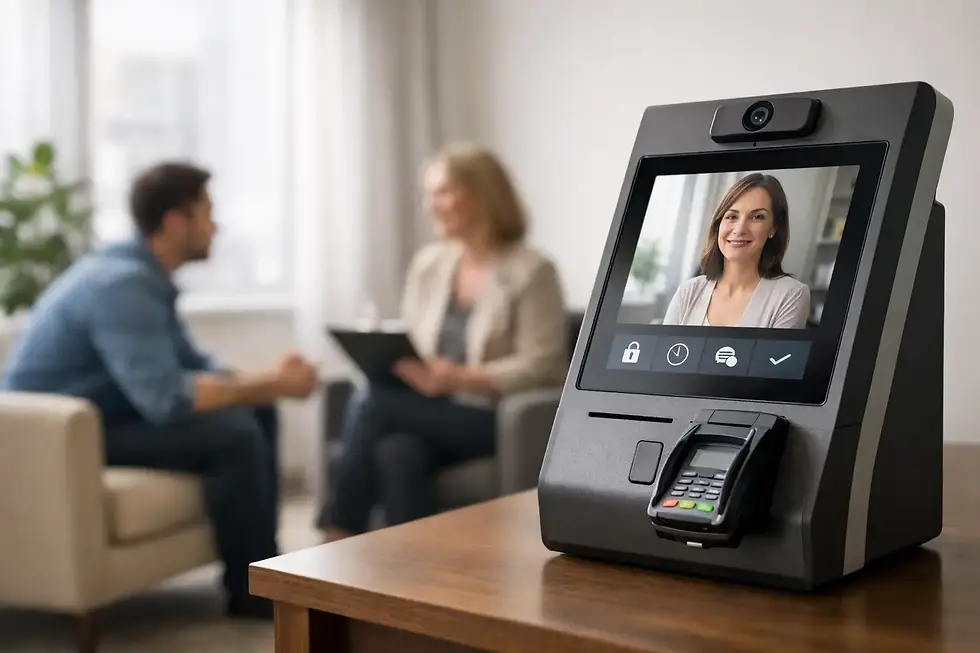
A dedicated iPad check-in station gives clients a clear, private action when they arrive. They enter their name or use a simple arrival prompt, and the practitioner receives a text or email notification. The client does not need to knock, search for someone, or wonder whether they have been noticed.
This option is particularly useful when the goal is presence rather than administration. Purple Couch App, for example, is designed around this brief moment: a client checks in on the lobby iPad, the provider is notified, and the session already in progress can continue without a verbal interruption. For practices that handle protected health information, choose a HIPAA-compliant solution and make sure its settings and usage fit your own privacy policies.
Choose based on the interruption, not the office size
It is easy to assume that a receptionist is the only professional option and that every alternative is a compromise. In many small practices, that is not true. The better question is: what happens when a client arrives while every available person is already serving someone else?
If your team has regular front-office coverage, a shared staff approach may be perfectly practical. If phone intake, insurance calls, and calendar management are taking up hours each week, remote support may make sense. But if arrival interruptions are the central pain point, a focused check-in tool is often the more proportionate answer.
A system should not require a new workflow for every part of your business just to solve one small but meaningful problem. The best reception alternative is often the one that removes uncertainty without asking you or your clients to learn a complicated process.
Build the arrival experience around privacy
Consider what a new client sees and hears in the first thirty seconds after walking in. Are they expected to call out? Do they stand near a closed door, unsure whether they should knock? Can they see names, appointment details, or paperwork belonging to others?
A calm arrival experience starts with a visible instruction at the entrance or waiting area. A simple message such as “Please check in when you arrive” is enough when the device is ready and easy to use. Position the iPad where clients can access it naturally, but not where they feel on display to people passing in the hallway.
The notification should be discreet as well. A text or email lets you decide when to look at it, rather than demanding an immediate response in the middle of a difficult conversation. If you are finishing with another client, the arriving person has still completed a clear action and knows their presence has been acknowledged.
Keep the technology out of the way
The point of a self-check-in station is not to add another screen to manage. It is to make the front of your office feel settled. Avoid a setup that asks clients to create accounts, download an app, navigate several screens, or enter more information than is needed to announce their arrival.
A dedicated iPad can remain in the lobby, powered and ready during business hours. For offices with unreliable Wi-Fi, cellular-capable options can be worth considering so the check-in experience does not depend on a weak signal. Test the notification method yourself from the waiting area before relying on it during a full day of appointments.
It also helps to plan for ordinary exceptions. Decide what a client should do if they arrive after hours, need accessibility support, or cannot use the screen comfortably. A small sign with a backup instruction can provide reassurance without making interruption the default.
Let the front door support your boundaries
Practitioners are often generous with access to their time and attention. Yet a clear arrival process is not cold or impersonal. It is a boundary that tells both clients what to expect: the person in the room is being cared for now, and the person arriving will be cared for next.
That consistency can be especially meaningful in practices built on trust. A therapy client may feel safer knowing that no one will walk in unannounced. A patient may appreciate not having to disclose their arrival to a crowded front desk. A salon or studio client may simply enjoy entering a space that feels organized rather than uncertain.
The best reception alternative does not make your practice feel automated. It makes room for the human attention your clients came for. When arrivals have a quiet, reliable path, you can finish the conversation in front of you with care, then greet the next person without rushing either moment.


Comments