

Client Check-In That Protects Session Time
- karl50784
- Aug 15
- 5 min read
A client arrives five minutes early while you are in the middle of a meaningful conversation, treatment, or service. They may knock, hover in the hallway, or quietly wonder whether they are in the right place. You have a choice no practitioner wants to make: interrupt the person in front of you or leave the arriving client uncertain.
A thoughtful client check-in process removes that choice. It gives the arriving person a clear next step and lets you know they are there without breaking the focus, privacy, and emotional tone of the appointment already underway.
For a small practice without a full-time receptionist, that is not a minor administrative detail. It is part of the care experience.
Why client arrivals can change the tone of your space
Most small offices are designed around personal attention. A therapy room, treatment suite, salon chair, studio, or private consultation space works best when the person being served feels that they have your full attention.
An unexpected arrival can shift that feeling quickly. A knock on the door can pull a therapist out of a sensitive moment. A practitioner may feel pressure to step out and greet the next client, even when doing so shortens or disrupts the current session. The client who has arrived may be just as uncomfortable, unsure whether to sit down, announce themselves, or wait in a shared hallway.
These are awkward waiting moments, not because anyone has done anything wrong, but because the office lacks a clear arrival ritual. When people do not know what to do, they create work for each other.
A reliable check-in process quietly answers the questions on both sides. The arriving client knows they have been seen. The practitioner knows the client is safely there. The current appointment continues without an unnecessary interruption.
What a good client check-in should do
The best systems are almost invisible. They do not turn a calm, personal office into a corporate reception desk. They simply create a respectful handoff between arrival and appointment.
For most solo practitioners and small teams, a check-in process should make three things happen: the client identifies that they have arrived, the right person receives a private notification, and the client can wait without needing further direction. If those steps are clear, everything just flows better.
This is why simplicity matters. A process with too many prompts, forms, logins, or instructions can make clients feel like they are completing paperwork instead of arriving for care. On the other hand, a handwritten sign asking clients to knock can create uncertainty and still asks you to manage interruptions in real time.
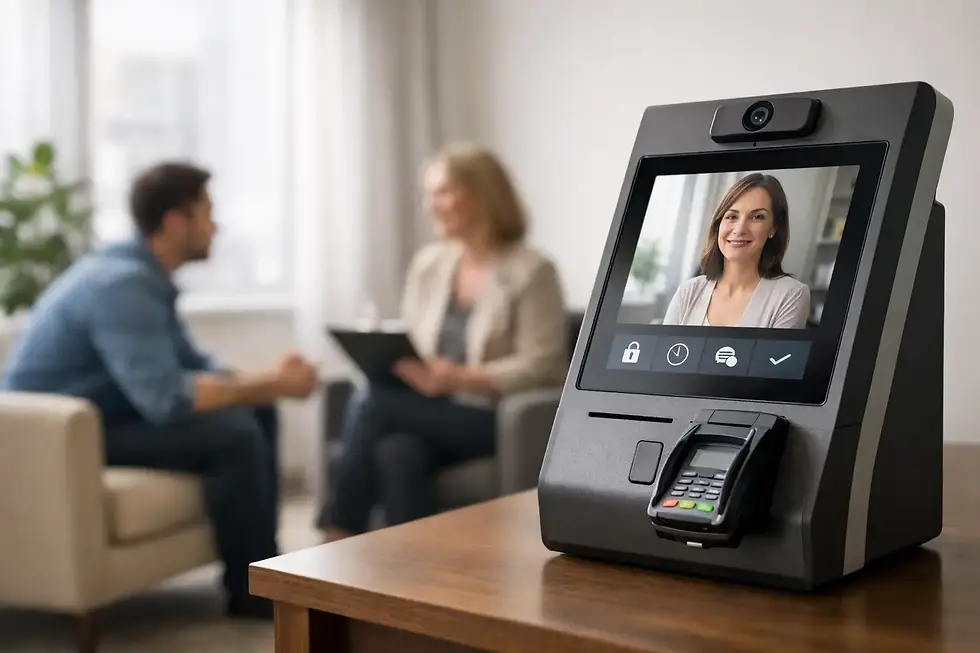
The right amount of technology is often very small: one iPad in the lobby or waiting area, a simple check-in screen, and a text or email notification to the practitioner. Purple Couch App is built around that intentionally focused workflow, with a HIPAA-compliant iPad check-in experience that can be set up in minutes.
A client check-in process that feels natural
A client should not need a tutorial to tell you they have arrived. The screen should be easy to understand at a glance, with language that feels welcoming rather than procedural. For many offices, a simple prompt such as “Please check in” is enough.
After checking in, the client needs reassurance. Depending on the setting, that could mean a brief message that their provider has been notified, a comfortable place to sit, or guidance about what happens next. The goal is not to make clients wait longer. It is to remove the uncertainty that makes even a short wait feel uncomfortable.
The practitioner, meanwhile, receives a discreet notification. A text may be best when you are moving between rooms or working in a larger suite. An email may be enough for a quieter office. The ideal choice depends on how quickly you need to see arrivals and what feels appropriate during your workday.
There is a useful boundary here: a notification is information, not an obligation to respond instantly. If you are in a session, procedure, or service, you can finish the moment you are in and greet the next client when you are ready. The system supports presence rather than creating another demand on it.
Keep privacy at the center of the experience
For therapy practices, medical offices, and wellness providers, the way people arrive can carry privacy implications. Clients may not want to say their name aloud in a hallway. They may not want to interrupt a closed-door session. They should not be asked to disclose more than is necessary just to let you know they are present.
A private digital check-in can be more comfortable than a verbal announcement, particularly in shared offices or waiting areas. It creates a quieter arrival experience and reduces the chance that one client’s presence becomes another person’s business.
Privacy is also about the feeling of the space. When clients are greeted by a clear, respectful process, they are less likely to feel exposed, forgotten, or as though they need to compete for attention. That matters in any client-centered business, but especially where trust is central to the work.
If you use a check-in system in a regulated setting, consider the details of your workflow. Keep the information requested at check-in minimal. Place the iPad where clients can use it comfortably. Confirm that notifications go only to the appropriate team members. A simple process can still be thoughtfully designed.
The trade-off between personal greetings and uninterrupted care
Some practice owners worry that self-check-in will feel less personal than greeting every client at the door. That concern is understandable. A warm welcome matters.
But personal does not always mean immediate. If greeting a new arrival requires you to abruptly step away from someone else, the welcome can come at the expense of the client already in your care. A well-designed check-in process gives you a way to honor both people.
You can still greet clients warmly when the appointment begins. You can still create a beautiful waiting area, offer clear directions, and make your space feel like your own. The iPad simply handles the part that does not require your voice: letting you know someone has arrived.
For some businesses, a receptionist is the right choice. A busy multi-provider office with frequent walk-ins, complicated intake needs, or high call volume may benefit from dedicated front-desk support. But for a solo clinician, independent stylist, massage therapist, or small studio owner, hiring someone just to monitor arrivals is often impractical. A lightweight check-in tool can provide the needed structure without adding staffing cost or operational complexity.
Small details that make check-in easier
Where you place the iPad matters. It should be visible as soon as a client enters, without making them search for it or pass through a private area. A small, calm sign can help first-time visitors understand what to do, especially if your entrance is shared with other businesses.
Connectivity matters, too. If your office Wi-Fi is inconsistent, choose a setup that can work with cellular service where needed. Test notifications from the actual waiting area, not just from your desk. A check-in tool only reduces anxiety if the notification reliably reaches you.
It also helps to think about exceptions. What should a client do if they arrive very early? If the iPad is temporarily unavailable? If they are bringing a child or support person? A short, human instruction can cover these moments without turning the lobby into a rulebook.
For example, you might let early arrivals know they are welcome to check in and wait, while making clear that you will come out at their scheduled time. That preserves boundaries without making anyone feel unwelcome.
Let the arrival feel as considered as the appointment
Your work asks you to notice people. The way clients enter your space should reflect that same care, even when you are not available to greet them immediately.
A clear client check-in gives people a quiet signal: you are expected, your arrival has been received, and you do not need to interrupt to be acknowledged. That small bit of clarity protects the session already happening and helps the next one begin on steadier ground.


Comments