

A Front Desk Alternative for Focused Care
- karl50784
- 6 days ago
- 5 min read
A client arrives a few minutes early, opens the door quietly, and looks around for someone to tell. You are in the middle of a session. The client in front of you notices the movement. The arriving client is left wondering whether to knock, wait in the hallway, or interrupt.
For a small appointment-based practice, a front desk alternative is not simply a way to save on staffing. It is a way to protect the attention, privacy, and calm that clients come to you for. The right approach gives arriving clients a clear next step while allowing you to stay fully present with the person you are already serving.
Why the traditional front desk no longer fits every practice
A staffed reception desk can be valuable in a busy, multi-provider office with constant phone calls, walk-ins, payments, and changing schedules. But many therapy practices, wellness offices, salons, studios, and private clinical spaces do not need that level of administration all day long.
What they need is a reliable way to handle one small but meaningful moment: arrival.
Without a receptionist, practitioners often create workarounds. They ask clients to text when they arrive, leave the door unlocked and listen for footsteps, check the hallway between appointments, or pause a conversation to answer a knock. Each solution may work sometimes. None creates the consistently settled experience clients expect.
The cost is not only practical. When you turn away from a client mid-session to manage the door, even briefly, the room changes. A difficult story is paused. A consultation loses its thread. A haircut, treatment, or coaching conversation becomes divided by logistics.
Meanwhile, the person who has just arrived may feel uncertain. They do not know whether they are early, whether they should announce themselves, or whether they have entered the right place. Those awkward waiting moments can set the tone before the appointment even begins.
What a thoughtful front desk alternative should do
A good replacement for a traditional reception desk should be intentionally narrow. It does not need to turn a small practice into a corporate lobby. It needs to make arrivals feel clear and cared for.
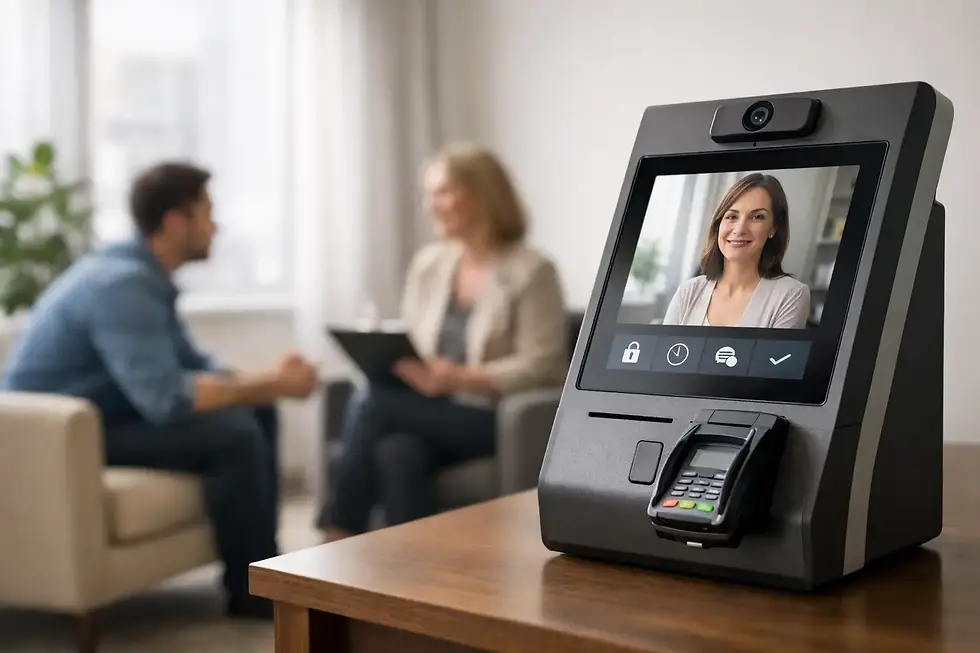
The simplest model is an iPad placed where clients naturally enter. They see a friendly check-in screen, enter the information you ask for, and receive confirmation that you know they are there. You receive a text or email notification. The client waits comfortably, and you continue your current appointment without a verbal interruption.
That small sequence addresses several needs at once. Clients are not left guessing. Practitioners do not have to monitor the door. The waiting area feels organized without feeling formal or impersonal.
Presence is the real benefit
Most practitioners did not choose their work because they wanted to become expert lobby managers. They chose it because they care about the person sitting across from them.
A front desk alternative supports that care by removing a repeated distraction. You do not have to choose between being polite to the arriving client and attentive to the current one. Both people are acknowledged in the right way.
For therapists and counselors, this can be especially meaningful. Privacy and emotional safety are part of the service, not an add-on. A quiet, self-directed arrival can feel more respectful than asking a client to knock on a door during someone else’s session. For wellness and medical providers, it can reduce confusion in shared buildings or offices without a dedicated reception team. For salon and studio owners, it helps the experience feel polished even when everyone is hands-on with clients.
Professional does not have to mean complicated
Some business owners hesitate because they assume a digital check-in system will require onboarding, new hardware, complicated integrations, or another dashboard to manage. That concern is reasonable. A system that creates more administrative work is not solving the problem.
For many small offices, the best setup is the one that disappears into the day. An iPad is already familiar to most clients. The check-in flow should take only a moment. Notifications should arrive where you will actually see them, without requiring you to keep a computer screen open.
Purple Couch App is built around this kind of simple arrival experience: a client checks in on an iPad, the practitioner receives a text or email, and the session in progress stays uninterrupted. It is designed for practices that need a calm presence at the door, not a sprawling visitor-management system.
How to choose the right approach for your space
Not every front desk alternative is right for every office. Before choosing one, consider what actually happens when clients arrive.
If you work alone behind a closed door, immediate notification may matter most. If several practitioners share a space, make sure each person can be notified appropriately and that the check-in experience does not reveal more information than necessary. If your office has unreliable Wi-Fi, look for a setup that can support cellular connectivity rather than leaving clients with a frozen screen.
Think about the physical environment, too. The iPad should be easy to spot but not placed where clients feel exposed while checking in. A small stand near the entrance or waiting area is often enough. The screen language should be warm and obvious: check in, take a seat, and know that your provider has been notified.
The goal is not to add a barrier between you and your clients. It is to remove uncertainty from the first few minutes of their visit.
Keep the arrival flow small
It can be tempting to use a check-in screen for everything: detailed intake forms, payment requests, marketing questions, policy acknowledgments, and scheduling changes. Those tasks may have a place elsewhere, but they can make an arrival feel transactional and slow.
For a calm practice, use the check-in moment for what it is. Confirm that the client is here. Let them know what happens next. Notify the right person.
A short flow is easier for clients who are nervous, running late, carrying a bag, managing a child, or simply unfamiliar with your office. It also reduces the chance that you will need to troubleshoot a screen while trying to begin your next appointment.
The trade-offs to consider
A digital check-in station is not a complete replacement for every receptionist function. If your team spends most of the day answering phones, processing complex insurance questions, managing high visitor volume, or coordinating multiple rooms, you may still need dedicated administrative support.
But those needs are different from the arrival-interruption problem. Many small practices do not need a person at a desk from morning to evening. They need clients to be welcomed reliably while the practitioner remains focused.
There is also a human element to consider. Some clients may need help checking in, especially if they have accessibility needs or are not comfortable with technology. The best systems account for this with large, clear prompts and a workflow that does not demand much typing. You can also keep a simple backup plan, such as a discreet sign with instructions for clients who need assistance.
Privacy deserves careful thought as well. In healthcare and therapy settings, choose a service that is designed to support HIPAA-compliant use and configure the display so it collects only what is necessary. Avoid asking clients to share sensitive details in a public waiting area. Arrival is a moment for recognition, not disclosure.
A calmer way to start every appointment
The quality of a client experience is often decided in small moments that never appear on an invoice. A client who walks in and immediately knows what to do feels expected. A practitioner who does not have to break eye contact or stop a session can give better attention. A waiting room that runs quietly tells people that their time and privacy matter.
You do not need a full reception department to create that feeling. You need a clear, dependable arrival routine that fits the size and tone of your practice.
When clients can check in confidently and you can stay with the person in front of you, the day feels less interrupted. More importantly, your space keeps making the same promise from the door onward: you are here, you have been noticed, and your time will be treated with care.


Comments